Summary from Leader Bergslagen
- The long-term budget brings together several EU funds in a common plan.
- Leader mandatory action to Rural areas with special restrictions.
- Budget size unknown. The Swedish Board of Agriculture is now working on developing proposals for measures that include Leader.
The government has developed a strategy for the common agricultural policy from 2030 onwards. The direction of the strategy is also important for the work with Leader.
To do in Leader Bergslagen 2026-2027
- Implement and finalize ongoing cases.
- Evaluate current programs.
- Discuss a suitable geographical delimitation for the leader area.
- Plan for co-financing together with public actors.
- Leader Bergslagen will begin developing a new strategy at the end of 2026.
- The goal is for the next period to start in 2028.
Preliminary timetable from the Swedish Board of Agriculture
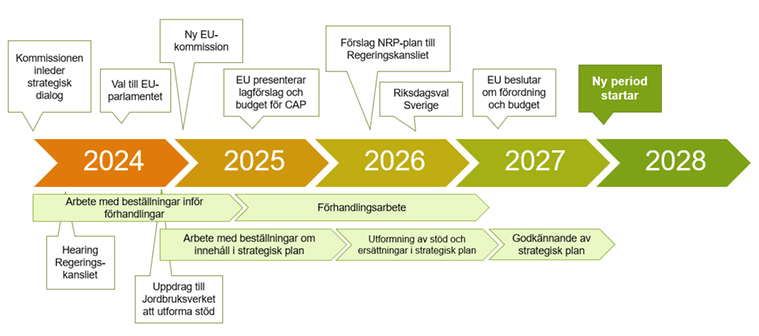
Preparations for the next period for Leader 2028–2034 ongoing in both the EU and Sweden
Negotiations on the next programming period are ongoing and the status in April 2026 is as follows.
- The European Commission has proposed that the new long-term budget for 2028–2034 will bring together several EU funds in a single common plan per member state. The plan is called a national and regional partnership plan.
- The new plan will cover several policy areas such as agriculture, rural development, fisheries, cohesion, migration and social inclusion. This means that there will be no strategic plan for the common agricultural policy or a maritime, fisheries and aquaculture programme in the next period.
Leader in the EU's upcoming regulations
The European Commission's proposal for new legislation for the next period states that member states should provide support to Leader in rural areas with specific constraints. It is up to each Member State to define which areas are covered.
The previous earmarking of 5 percent of the budget for Leader no longer exists. At the same time, Leader a mandatory measure according to the bill. This means that Leader is competing for budget together with other efforts in the negotiations. At present, it is therefore not possible to say how large the budget for Leader will be in the next period.
The authorities should develop proposals
The government has tasked the Swedish Board of Agriculture, together with several other authorities, to propose support, compensation and other measures that can be included in Sweden's national and regional partnership plan.
The Swedish Board of Agriculture must, among other things, describe how the proposed measures contribute to meeting national and regional challenges. The proposals must take into account the specific conditions, needs and challenges that exist in different geographical areas.
They should also be gender mainstreamed, which means that a gender perspective should be included in all decision-making, at all levels and in all stages of the process.
The work of the Swedish Board of Agriculture
The Swedish Board of Agriculture is now working on developing scalable proposals for the national and regional partnership plan. This work includes, among other things,
- develop proposals for measures where Leader included
- make cost assessments for different alternatives
- define rural areas with specific constraints.
The Board of Agriculture will report on the assignment in October 2026. Until then, there is no clear political direction for Leader in the next period. This means that the work on the introduction of Leader, such as the development of strategies, can start no earlier than autumn 2026.
In order not to delay the implementation further, the Swedish Board of Agriculture is simultaneously reviewing how we can simplify the implementation process, with the goal that the next period can start during 2028.
The government's strategy for the common agricultural policy
The government has developed a strategy for the common agricultural policy from 2030 and beyond, and the direction of the strategy is also important for the work on Leader. The strategy points out that agricultural policy should
- stimulate active agriculture and increased food production throughout Sweden
- enable more young people and people outside the industry to establish themselves in agriculture
- build competitiveness and profitability as a basis for increased robustness
- strengthen companies' innovation, access to capital and productivity - while reducing climate and environmental impact through restructuring and smart use of resources.
So can leaderareas to prepare in 2026
Even though the Swedish Board of Agriculture does not yet know much about the direction for the coming period, there are areas where existing leaderAreas can prepare now to be as well equipped as possible for the next period.
- Evaluate what has worked well and what may need to be developed.
- Discuss an appropriate geographical delimitation for leaderthe area.
- Plan for co-financing together with public actors.
Starting this work well in advance creates better conditions for future decisions and the introduction of the next period.
Do you have any questions? For questions, you can contact LLUprogramledning@jordbruksverket.se
The association Local development Sweden which brings together all Leader areas in the country conveyed the following at its information meeting on 2026-02-03
Leader will be mandatory for member states to participate in, but there are no earmarked funds.
It will be a multi-fund solution, with reduced funds for CAP.
Reduced co-financing from the EU, previously 50% reduced to 40%.
Local Development Sweden has also submitted a response to the consultation The European Commission's proposal for a new regulation establishing a new framework for monitoring budget expenditure and implementation. They wrote
Local Development Sweden (LUS) welcomes the Commission's ambition to simplify the regulations and reduce bureaucracy in order to simplify the work. Here, LUS would like to emphasize that the simplification ambition needs to have an impact in the national NRPP plan, since previous simplification initiatives have led to regulations in Sweden that have been more extensive than the ambition from the Commission. Local Development Sweden emphasizes the importance of LEADER being available throughout the country. For equitable rural development, rural areas should not be set against each other and it is essential that the EU first, and then the Member States, earmark and allocate funding for long-term rural development with at least the same amount as the current programming period.
Swedish positions
The Swedish fundamental starting point in the work on the upcoming reform is that it should lead to profitability, competitiveness and simplification. At the same time, the policy should contribute to the fulfillment of jointly decided environmental and climate commitments. A changed environment also means an increased focus on promoting robust primary production throughout the country that can contribute to a secure food supply.