The association Local development Sweden which brings together all Leader areas in the country conveyed the following at its information meeting on 2026-02-03
Leader will be mandatory for member states to participate in, but there are no earmarked funds.
It will be a multi-fund solution, with reduced funds for CAP.
Reduced co-financing from the EU, previously 50% reduced to 40%.
Local Development Sweden has also submitted a response to the consultation The European Commission's proposal for a new regulation establishing a new framework for monitoring budget expenditure and implementation. They wrote
Local Development Sweden (LUS) welcomes the Commission's ambition to simplify the regulations and reduce bureaucracy in order to simplify the work. Here, LUS would like to emphasize that the simplification ambition needs to have an impact in the national NRPP plan, since previous simplification initiatives have led to regulations in Sweden that have been more extensive than the ambition from the Commission. Local Development Sweden emphasizes the importance of LEADER being available throughout the country. For equitable rural development, rural areas should not be set against each other and it is essential that the EU first, and then the Member States, earmark and allocate funding for long-term rural development with at least the same amount as the current programming period.
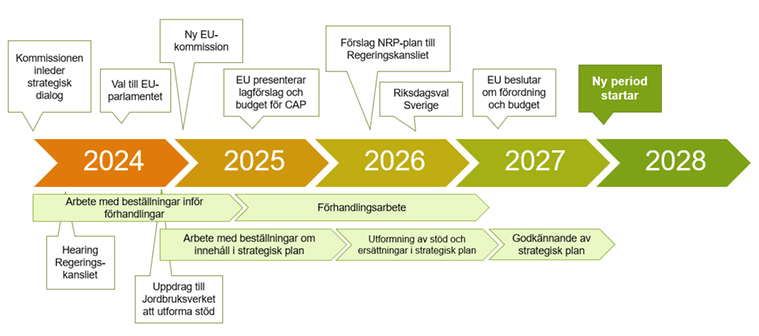
Preliminary timetable from the Swedish Board of Agriculture
The new period starts in 2028. The timetable is still preliminary, but in the picture you can see approximately when different parts that are connected to the upcoming CAP will take place. The Government Offices will anchor the work on several occasions and provide opportunities for input from external actors.
Swedish positions
The Swedish fundamental starting point in the work on the upcoming reform is that it should lead to profitability, competitiveness and simplification. At the same time, the policy should contribute to the fulfillment of jointly decided environmental and climate commitments. A changed environment also means an increased focus on promoting robust primary production throughout the country that can contribute to a secure food supply.